Functional network segregation moderates the association between amyloid burden and cognitive decline

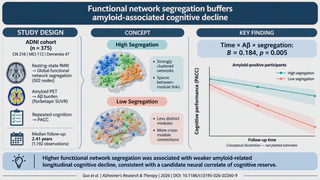
Background Functional brain network segregation, the normalized difference between within- and between-system connectivity, has been proposed as a candidate neural correlate of cognitive reserve (CR). However, whether system segregation moderates the association between amyloid-β (Aβ) pathology and cognition remains unclear. We tested whether higher global system segregation attenuates the adverse association of Aβ burden with cognitive decline. Secondary objectives were to examine nonlinear patterns across the amyloid continuum and network-specific moderation effects.
Methods We conducted a longitudinal cohort study using data from the Alzheimer’s Disease Neuroimaging Initiative (ADNI). Global segregation was computed from resting-state fMRI using a 502-node parcellation. Aβ burden was measured by [¹⁸F]-florbetapir positron emission tomography (PET) composite standardized uptake value ratio (SUVR). Cognition was assessed by modified Preclinical Alzheimer Cognitive Composite (PACC). Linear mixed-effects models (LME) were used to test whether system segregation moderated the association between Aβ burden and cognitive change over time, adjusting for age, sex, education, APOE ε4 status, baseline diagnosis, and head motion. Cross-sectional, two-stage longitudinal, restricted cubic spline (RCS), and network-specific analyses were also conducted.
Results The analytic sample included 375 participants, comprising 216 cognitively normal (CN) individuals, 112 with mild cognitive impairment (MCI), and 47 with dementia. Higher Aβ burden was associated with poorer baseline cognitive performance (B = − 0.591, p = 0.008), whereas higher system segregation was associated with better cognition (B = 0.501, p = 0.011). A significant Time × Aβ burden × system segregation interaction was found (B = 0.184, p = 0.005), indicating a weaker association between Aβ burden and cognitive decline at higher levels of segregation. Findings were consistent in cross-sectional, two-stage longitudinal, ≥ 2-visit, and dementia-free sensitivity analyses. RCS analyses further indicated that participants with higher segregation showed less annual PACC decline across levels of Aβ burden with no evidence of steeper decline at higher Aβ levels. Network-specific moderation effects were most evident for global cognition.
Discussion These findings support functional network segregation as a candidate neural correlate of CR. Preserved large-scale network organization may contribute to cognitive resilience by reducing the cognitive consequences associated with increasing Aβ burden across the AD continuum. Further longitudinal and multimodal studies are needed to clarify the underlying mechanisms.
