Lonely individuals show more tau pathology in Alzheimer's Disease

Background Loneliness was associated with increased dementia risk and severity of Alzheimer’s disease (AD) pathology, such as amyloid-β (Aβ) and tau accumulation in the early stage. We aimed to assess how loneliness affects the process of AD pathology. Specifically, we focus on the amygdala, a brain region closely associated with loneliness.
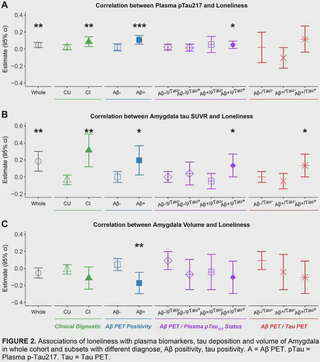
Method 274 cognitively unimpaired (CU) and 99 cognitively impaired (CI) participants from the Greater-Bay-Area Healthy Aging Brain Study (GHABS) were assessed for loneliness, isolation, and depression state by neuropsychiatric assessments. Among them, 274, 191, and 78 participants completed plasma phosphorylated tau217 (p-Tau217), Aβ positron emission tomography (PET) scan, tau PET scan. The demographic is shown in Table 1. In separate linear regression models, we compared the UCLA-loneliness score across different clinical groups (CU/CI), Aβ PET status (Aβ PET±), tau PET status (tau PET±), and plasma pTau217 status (pTau217±) by adjusting for social isolation, depression, education, age and sex. We subsequently evaluated the association of loneliness with plasma p-Tau217, amygdala tau PET standard uptake value ratio (SUVR), and amygdala volume in the whole cohort, and subsets with different diagnosis (CU/CI), Aβ positivity (A±), tau positivity (T±).
Result Loneliness level showed no significant difference between diagnostic groups, while it rises with onset of AD pathology, especially with the onset of tau pathology (tau PET and plasma p-Tau217) (Figure 1). Loneliness positively related to plasma p-Tau217 and amygdala tau deposition in whole cohort, especially in CI, Aβ+ group or Aβ+/p-Tau217+ (Figure 2). Amygdala volume showed a negative correlation with loneliness in the Aβ+ group.
Conclusion We found that the high loneliness level was associated with more tau pathology, especially in participants with cognitive impairment or who have Aβ pathology. These findings suggest a strong link between loneliness and tau pathology, providing novel insights into how the neuropsychiatry state affects tau aggregation in AD.
